

Get Free Tips - And Up Your Game!

Join over 4,779 smart punters getting our winning tips every morning directly to your email inbox, Professional tipster selections, tipster trials and more!

We respect your privacy. 100% free to join

Bookmakers Overround Explained – The Bookies Edge

The bookmaker’s overround is the bookmaker’s edge; it’s an amount of profit usually expressed as a percentage.

The Overround represents a percentage of profit they can achieve on a betting market, regardless of the result.

The market type and other factors can affect the overround from bookmaker to bookmaker, but there is always an overround for every betting market in the UK and Ireland.

You never meet a broke bookie, do you? There is a reason for that. The bookmaker’s business model is a tried and tested method that, if done right, can ensure they can make a living by providing a service to punters.

Overround Calculator

Outcome Fractional Odds Decimal Odds Implied Probability Calculation
Man City Win 4/5 1.80 55.56% (1 ÷ 1.80) × 100
Draw 12/5 3.40 29.41% (1 ÷ 3.40) × 100
Man Utd Win 9/2 5.50 18.18% (1 ÷ 5.50) × 100
TOTAL 103.15% Sum of all probabilities
Overround 3.15% Total – 100%
Bookmakers Overround Explained

How Bookmakers Make Money

Ok, so now you know what it is, let’s explain how it works in the bookmaker’s favour overall, with an example below.

An Example

There is a football fixture where Man City take on Man United on the 1×2 betting market, the home side being Man City and the away side their rivals, Man United.

Say the bookmaker feels the approximate probabilities for the full-time result are 40% for Manchester City to win, 30% for the game to end in a draw, and 30% for United to return to Old Trafford with three points for the win.

Market Type Typical Overround Range Example Why It Varies
Premier League Match Winner 2.5% – 5% Man City vs Arsenal: 3.2% High liquidity, competitive market
Championship Match Winner 4% – 7% Leeds vs Middlesbrough: 5.8% Less liquidity than Premier League
Horse Racing (Major Meetings) 10% – 15% Cheltenham Festival: 12% Multiple horses, more uncertainty
Horse Racing (Smaller Meetings) 15% – 25% Midweek Plumpton: 18% Lower betting volumes, higher risk
Tennis Grand Slam Match 3% – 6% Djokovic vs Nadal: 4.1% Two-player market, high volume
Accumulators (4+ selections) Compounds exponentially Four 3% overrounds = 12.5%+ Multiplies with each leg added

Odds

The odds presented by the bookmaker are 7/5 for 1 (home win), 11/5 for X (draw), and 12/5 for 2 (away win). Let’s look at those odds in a bit more detail. In the UK and Ireland, fractional odds are used, whilst in Europe, the familiar format is decimal odds, and with both, there is an associated implied probability.

For the odds quoted, the model looks like this: 1 (home win) = 7/5 (fractional odds) | 2.40 (decimal odds) | 41.67% Implied probability X (draw) = 11/5 | 3.20 | 31.25% 2 (away win) = 12/5 | 3.40 | 29.41%

Then let’s add up the total implied probability for the three possible outcomes of the game: 41.67% + 31.25% + 29.41% = 102.33% The numbers (prices or odds) and their associated implied probabilities provide the bookmaker in this instance with an overround of 2.33%, which guarantees the bookmaker a profit, regardless of the final score in that tasty Manchester City vs Manchester United fixture.

They have offered ‘good odds’ or a good price for the punter on the away win, as they took in enough cash on the other selections.
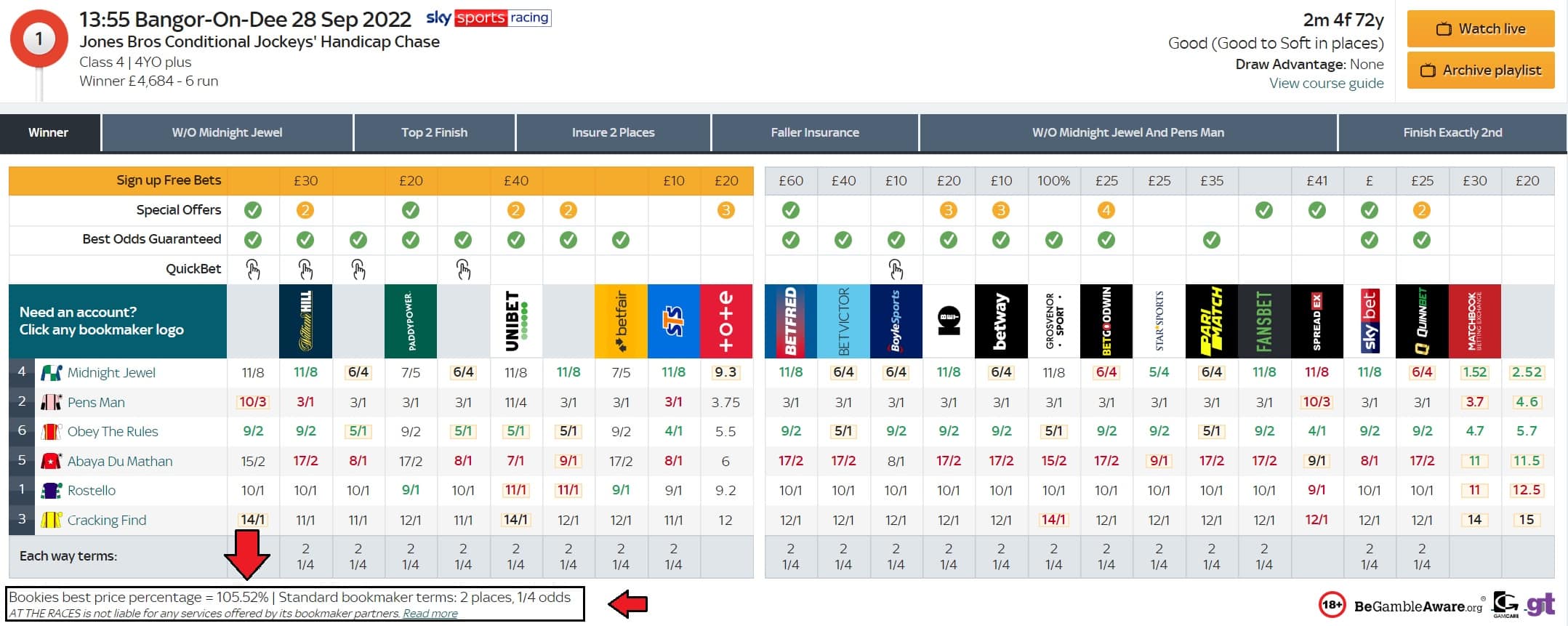
overround example

As you can see from an example from the Attheraces website above, the bookmaker’s overround was 105.52%, meaning that regardless of the result, the bookmaker will make 5.52% on all bets placed with them.

Outcome Bookmaker Odds Bookmaker Probability Fair Odds (No Overround) Fair Probability Value Gap
Liverpool Win 2.20 45.45% 2.29 43.75% You lose 0.09 in odds
Draw 3.60 27.78% 3.75 26.67% You lose 0.15 in odds
Chelsea Win 3.25 30.77% 3.39 29.58% You lose 0.14 in odds

Consider Accumulators And Multiples Overround

In the example above of the 2.33% overround from the 1X2 Man City vs Man Utd bet, you might think that is not much of a profit margin for the bookmaker.

Given the hundreds of thousands or even millions of bets taken by the bookmaker each year, those profits start to add up.

Indeed, bookmakers can also compound their profit margins by offering multiple bets such as doubles, trebles, Lucky 15, or even bigger football accumulators.

Say they offer similar 1X2 odds on two football matches, the bets become doubled for the punter (who has to predict the outcome of two games correctly), and the profit margin doubles 2.33% + 2.33% = 4.66%.

If it’s a five-match accumulator, those overround figures grow to 2.33% + 2.33% + 2.33% + 2.33% + 2.33% = 11.65%.
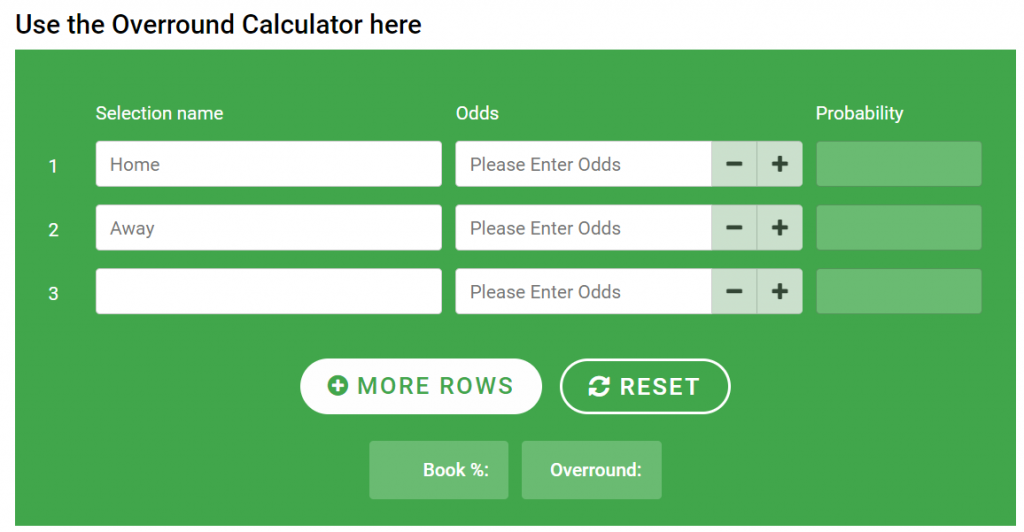
bookmakers overround calculator

Confused? Try An Overround Calculator

Bookmakers make much more money on multiple bets because the odds are increased, meaning you are less likely to get all the results correct, which means the bookie gets your money.

To make working out the bookmakers’ overround easier, why not try an overround calculator? It will tell you what you need to know once you put in a few simple details.

Frequently Asked Questions About Bookmakers’ Overround

What is an example of an overround?

A simple example: In a tennis match between Djokovic and Nadal, the bookmaker offers these odds:

  • Djokovic to win: 1.85 (implied probability: 54.05%)
  • Nadal to win: 2.10 (implied probability: 47.62%)

Adding these probabilities: 54.05% + 47.62% = 101.67%

Since this exceeds 100%, the overround is 1.67%. This means the bookmaker has built in a 1.67% profit margin on this market.

How do you calculate overround?

Follow these three steps:

Step 1: Convert each outcome’s decimal odds to implied probability using: (1 ÷ decimal odds) × 100

Step 2: Add all the implied probabilities together

Step 3: Subtract 100 from the total. The result is the overround percentage.

Example Calculation:

  • Man City: 1.80 → (1÷1.80)×100 = 55.56%
  • Draw: 3.40 → (1÷3.40)×100 = 29.41%
  • Man Utd: 5.50 → (1÷5.50)×100 = 18.18%
  • Total: 103.15%
  • Overround: 3.15%

What does overround percentage mean in racing?

In horse racing, the overround percentage represents the bookmaker’s built-in profit margin on that specific race. A typical horse racing overround is 15-20% for standard races, but can reach 25%+ for small meetings with limited betting volumes.

For example, a race with a 118% book means the overround is 18%. If bettors collectively wagered £1,000 on this race in perfect proportion to the odds, the bookmaker would pay out approximately £820 in winnings while keeping £180 (18%) as profit regardless of which horse wins.

Horse racing overrounds are significantly higher than football or tennis because:

  • More possible outcomes (8-20 horses vs 2-3 outcomes)
  • Greater information asymmetry (trainer/jockey factors harder to quantify)
  • Lower betting volumes on smaller meetings increase bookmaker risk

Can bookmakers change the overround during betting?

Yes, constantly. The overround fluctuates based on betting patterns and market conditions. As money comes in on particular outcomes, bookmakers adjust odds to balance their liability, which changes the overall overround.

Example: Pre-match, a football match might have a 103% book (3% overround). As kickoff approaches and heavy betting favors the home team, the bookmaker shortens home odds and lengthens away odds, potentially increasing the book to 105% (5% overround) to protect their position.

In-play betting typically shows higher overrounds (often 5-8%) because:

  • Rapid odds changes increase bookmaker risk
  • Less time for arbitrage opportunities to be exploited
  • Information advantage shifts toward those watching the event live

What’s a good overround for bettors?

Excellent (Under 3%): Rare but found on major tennis matches or high-liquidity football markets. These represent the fairest betting opportunities available.

Good (3-5%): Common on Premier League football, major tennis tournaments, and high-profile matches. Sustainable long-term betting is possible with disciplined strategies.

Average (5-8%): Standard for most mainstream sports betting. Requires strong analysis and selective betting to overcome the bookmaker’s edge.

Poor (8-15%): Common in lower-league football, niche sports, or complex markets. Very difficult to profit consistently.

Avoid (15%+): Typical of small horse racing meetings, accumulators, and novelty markets. The bookmaker’s edge is so large that long-term profitability is extremely difficult even for skilled bettors.

How does overround affect accumulator bets?

Overrounds multiply in accumulators, creating a compounding disadvantage. Each selection adds another layer of bookmaker margin.

Example – Four-Fold Accumulator:

  • Each individual selection has a 3% overround (103% book)
  • Combined effect: 1.03 × 1.03 × 1.03 × 1.03 = 1.1255 (112.55% book)
  • Total overround: 12.55%

This means a four-fold accumulator with 3% overround per leg gives the bookmaker a 12.55% edge – more than four times worse than betting on each selection individually.

For a practical context, using our betting bankroll calculator with a £1,000 bankroll and £10 stakes, you’d need approximately a 56% win rate on single bets to break even with a 3% overround. For that same four-fold accumulator with 12.55% overround, you’d need nearly 65% win rate – a massive difference.

Key Takeaway: Accumulators are entertaining but mathematically disadvantageous. The compounding overround makes them one of the bookmaker’s most profitable products.

Should I always choose the bookmaker with the lowest overround?

Generally, yes, but with important considerations:

Advantages of Low Overround Bookmakers:

  • Better long-term value on every bet
  • Higher potential returns over time
  • More sustainable betting approach

Other Factors to Consider:

  • Account Restrictions: Low-margin bookmakers often restrict winning accounts faster
  • Liquidity: Best odds mean nothing if you can’t get your stake on
  • Promotions: Sometimes, higher-overround bookmakers offer bonuses that compensate
  • Betting Limits: Lower margins may come with lower maximum stakes

Strategic Approach: Use multiple bookmakers to always access the best available price for each specific bet, rather than being loyal to one operator. This optimisation can improve your effective overround by 1-2% – a significant edge over time.

For horse racing specifically, consult our Cheltenham Festival betting guides which factor in overround analysis when recommending betting strategies for major racing events.

Summary – The bookie always wins

Now that you understand what the bookmakers’ overround is, you can see why the bookie always wins in the long run; they can make a profit from any sporting market they choose.

There are occasions where they can be caught out with massive odds bets, though. So if you were wondering how to become a bookmaker, you always need to make sure you have enough money to payout should the worst-case scenario occur (and it does more often than you would think).

Bookmakers can also limit the accounts of punters who are ultra-successful and often do so without warning.

Limiting accounts is something that we don’t think is fair, but it does happen very often to punters.

Why should a bookmaker limit your account, meaning you can bet when they can take your money all day long?