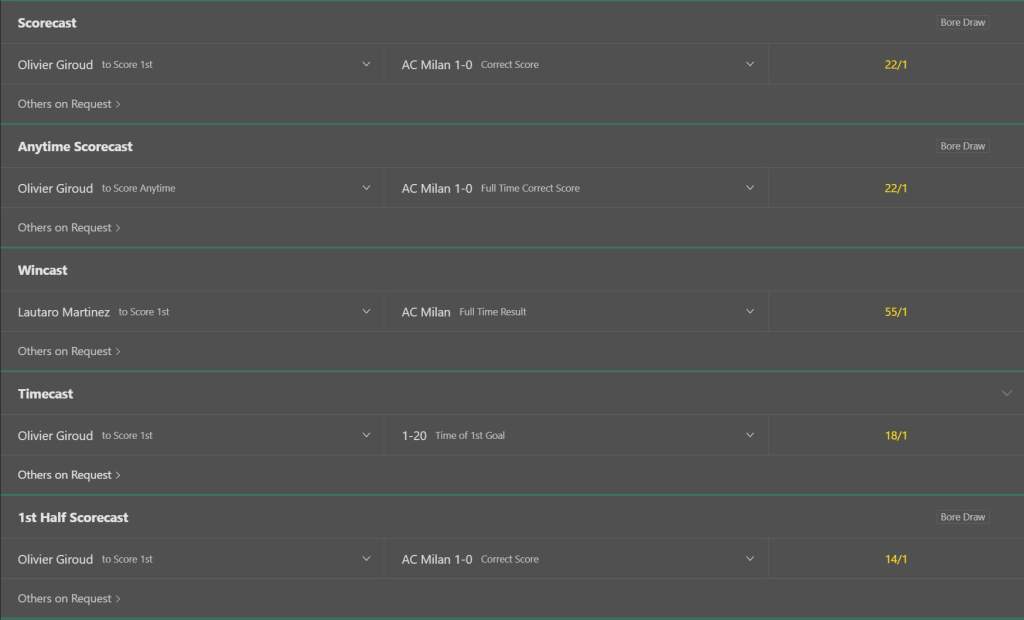

What is a Scorecast Bet?
A scorecast bet combines two predictions in a single wager – the first goalscorer and the final score of a football match. This bet wins only when both predictions are right, making it different from placing separate bets on these outcomes.
Scorecast betting gives you a high-risk, high-reward option that offers unusually high odds. Football bettors love these bets because they can wager on two prominent markets at once and get better odds than betting on each separately.
How It Works
| Step | Description |
|---|---|
| Select a match | Any football fixture where the bookmaker offers a Scorecast market. |
| Pick the exact score | Example: 2‑1, 0‑0, 3‑2, etc. |
| Choose the first‑goal scorer | A player from either team who you think will net the opening goal. |
| Place a single stake | The combined prediction is treated as one bet; if either part is wrong, the ticket loses. |
| Odds are calculated | The bookmaker multiplies the odds for the chosen score by the odds for the selected scorer, often resulting in 30‑to‑1 or higher. |
Why Punters Like Scorecast Bets
| Advantage | Explanation |
|---|---|
| High payouts | Small stakes can yield large returns because the market is difficult to hit. |
| Single‑ticket convenience | No need to place separate score and scorer bets; everything is bundled. |
| Strategic depth | Allows use of statistical analysis (e.g., expected goals, player form) to find value. |
| Excitement | Watching the match to see if the prediction comes true adds entertainment value. |
The bet works in a simple way. You pick a player you think will score first and predict the exact final score. Both picks become one bet instead of working as multiple bets. Your wager pays off only when both guesses hit the mark – your chosen player must score first, and the match must end with your predicted score.
To cite an instance, see a Chelsea versus Barcelona Champions League match where you might pick Lionel Messi as the first scorer with a 1-1 final score. The bookmaker might give you odds of 33/1 on this outcome. Your bet wins only if Messi scores first and the game ends 1-1. You lose if Messi scores first, but the game ends 2-1, or if it ends 1-1 but another player scores first.
These bets follow specific rules. Own goals don’t count toward the first goalscorer part of your bet. The next regular goal becomes relevant for your scorecast bet if the first goal is an own goal. The final score calculation includes own goals.
The odds climb a lot compared to single bets because getting both predictions right is tough. The bookmakers don’t just multiply individual bet odds since these events connect – your player scoring first affects your predicted score’s chances.
Most bookmakers turn your bet into a single correct score bet if your chosen player sits out the match. On top of that, your bet loses if your player comes in as a substitute before the first goal but doesn’t score it.
You can envision a scorecast bet as a small accumulator with two parts. Both predictions need to hit the mark for any payout, unlike separate bets, where one loss wouldn’t affect the other.
How to Place a Scorecast Bet
A scorecast bet combines two different predictions into one wager. Here’s how you can place this type of bet the right way.
Choose your first goal scorer
Your first task is to pick the player you think will score the first goal in the match. This choice sets the foundation for your scorecast bet. You should get into team news and starting lineups before making your pick. Note that your bet stays valid if your chosen player comes on as a substitute before the first goal. All the same, most bookmakers will change your bet to a correct score single if your player doesn’t play at all. Own goals usually don’t affect the first goalscorer part of your bet.
Pick the correct final score
The next step after picking your goalscorer is predicting the exact final score of the match. You’ll need to specify how many goals each team will score by the end of normal time. The score you predict should be the result after 90 minutes plus injury time, but doesn’t include extra time in knockout games. Team form, past matches, and scoring patterns can help you make a realistic prediction.
Find the scorecast market on your bookmaker
Here’s how to find the scorecast market on your bookmaker’s site:
- Log in to your bookmaker account
- Head to the football/soccer section
- Click on your chosen match
- Look for the “Scorecast” option in the available markets
Most betting sites put this market near the bottom of the betting options. You must use this special market to place scorecast bets instead of trying to combine correct score and first goalscorer as a double. The screen usually shows two dropdown menus – first goalscorer on the left and correct score on the right.
Set your stake and place the bet
The next step is clicking the displayed price to add your bet to the betslip. A scorecast works as one bet with a single stake amount, even though it combines two predictions. Just put your stake in the betslip and confirm your bet. Your stake goes on both predictions being right, rather than being split between them.
Smart bettors check scorecast odds on different betting sites before placing their bets, as prices can vary for similar selections. Scorecast markets often give you better odds than making the same bet as a double or bet builder.
What to Consider Before Betting
Betting success in scorecast requires solid research and analysis of several vital factors before you place your wager. You can make better informed predictions for both the first goalscorer and correct final score by learning about these elements.
Player selection and team news
Team news is the most vital step to selecting a potential first goalscorer. You should verify starting lineups just before kickoff. A player who doesn’t start or enter after the first goal can void that portion of your bet. Here are the essential player factors to think over:
- Current form: Review recent performances and goal-scoring patterns
- Injury history: Check if players are coming back from injuries that might affect their performance
- Fatigue levels: See if players have played many recent matches or had international duty
- Historical record: Some players tend to score against specific opponents
The core team’s suspensions and absences of defenders can create scoring chances for certain attackers. So staying updated with team news will give a better chance of not wasting your stake on unavailable players.
Match context and importance
A match’s significance affects how teams play. Teams fighting for titles, European qualification spots, or battling relegation play with more urgency than mid-table sides. Home versus away performance is vital too, since many teams show different patterns based on where they play.
Weather conditions change scoring patterns, especially with certain playing styles. Heavy rain or strong winds can affect high-scoring matches and alter your correct score prediction. Head-to-head history between teams often shows consistent patterns that might continue in upcoming games.
Scoring trends and averages
Statistical analysis helps learn about scorecast predictions objectively. You should calculate average goals scored and conceded by each team, both overall and in recent fixtures. This helps identify common scorelines in previous meetings between teams.
To name just one example, calculating team attack and defence ratings helps determine scoring probabilities. Find home attack strength by dividing goals scored (home) by games played, then repeat for away goals. Defensive strength comes from goals conceded metrics. These four values—home attack, away attack, home defence, away defence—are the foundations for predicting realistic scorelines.
Note that common scorelines like 1-0 and 2-1 usually have lower odds compared to unusual results or draws. Finding the right balance between probability and potential returns is essential when making your final scorecast selection.
Risks and Rewards of Scorecast Bets
Scorecast betting stands out as a classic high-risk, high-reward option in sports gambling. Getting both the first goalscorer and the exact final score right is tough, but that’s what makes this bet so exciting.
These bets are popular because of their generous odds. Bookmakers pay out much more compared to two separate bets. The high payouts make these bets attractive despite the challenge. To name just one example, common scores like 1-0 and 2-1 have lower odds, while draws and bigger scores like 4-1 tend to pay better because they don’t happen as often.
The flip side shows a different story. Your chances of winning are pretty slim since getting even one part right is a challenge. You need to nail two tough predictions at once – who’ll score first and what the final score will be. This makes scorecast betting one of the hardest markets to crack.
Smart bettors use strategies to reduce these risks. The quickest way is to place multiple scorecast bets. You might back one player to score first with different final scores, or pick one final score with different first goal scorers. This works if you do the math to make sure a win covers your total stake and still turns a profit.
The betting rules can work in your favour too. Many bookmakers turn your bet into a straight correct score wager if your chosen player doesn’t play or comes on after the first goal. This helps protect you from some bad scenarios.
These bets can drive you crazy when you get just one part right, but people love them because they’re fun and could pay big. Success in scorecast betting usually comes after you’ve done well in either correct score or goalscorer bets on their own.
Common Mistakes to Avoid in Scorecast Betting
Smart scorecast betting requires avoiding common mistakes. Bettors lose money due to these errors even when they get their analysis right.
Betting too early without lineup info
Placing scorecast bets too early can backfire. Most bookmakers will change your bet to a correct score single if your chosen player doesn’t start or comes in after the first goal. Your chances of winning improve when you wait for team lineups to be announced, about an hour before the game starts. Professional bettors know this well and hold off until they see the confirmed lineups.
Ignoring team form and stats
Data analysis makes a huge difference in scorecast betting success. Many bettors make basic mistakes – they bet just on winning streaks, let emotions guide their picks, or ignore who the opponent is. Your first goalscorer picks need solid backing from player stats, injury updates, tiredness levels, and past scoring records against specific teams.
Choosing unrealistic scorelines
New bettors often pick unlikely scorelines. Team stats about goals scored and conceded should guide your predictions. High-scoring results might show attractive odds, but they rarely pay off.
Overlooking bookmaker rules
Each bookmaker has different scorecast rules. Own goals don’t usually count for first goalscorer bets, but affect the final score. The rules also say that if a game stops after someone scores, combo bets become first goalscorer singles. Reading the fine print of each bookmaker’s terms saves you from losing money needlessly.
Tips to Improve Your Scorecast Success
- Analyse team scoring patterns – Look at how often a team scores first and typical scorelines (e.g., 1‑0, 2‑1).
- Identify likely first‑goal scorers – Players who frequently start matches, take set‑pieces, or have a high shot‑on‑target rate.
- Use expected‑goals (xG) data – Compare the xG for the first 15‑20 minutes to gauge early‑goal likelihood.
- Consider home‑advantage – Home teams often score first and influence the final score.
- Shop odds – Different bookmakers may price the same Scorecast differently; pick the best value.
- Bet modestly – Treat Scorecast as a high‑risk, high‑reward “fun” bet; keep stakes within your bankroll limits.
Example Scorecast Bet
| Match | Predicted Score | First‑Goal Scorer | Combined Odds |
|---|---|---|---|
| Liverpool vs. Brighton | 2‑0 | Mohamed Salah | 45.0 (≈ 44‑to‑1) |
Why this works: Liverpool’s home record shows a high frequency of opening the scoring, Salah is the team’s top scorer and often nets early, and Liverpool’s recent matches frequently end 2‑0 or 3‑1, making the combined odds attractive.
Key Takeaways For Scorecast Betting
Scorecast betting combines predicting the first goalscorer and the exact final score in one wager, offering high rewards but requiring both predictions to be correct for any payout.
• Wait for team lineups before betting – if your chosen player doesn’t start or enters after the first goal, most bookmakers convert your bet to correct score only • Analyze team form, scoring trends, and head-to-head statistics to make realistic predictions rather than chasing high-odds unlikely scorelines • Consider placing multiple scorecast bets on the same match with different combinations to increase winning chances while managing risk • Understand bookmaker rules – own goals don’t count for first goalscorer but do count for final score predictions • Focus on common scorelines like 1-0 or 2-1 for better probability, though they offer lower odds than unusual results
Scorecast betting essentially functions as a mini-accumulator requiring exceptional accuracy, making it one of the most challenging yet potentially rewarding betting markets available.
Scorecast Bet FAQs
Q1. How does a scorecast bet differ from regular betting? A scorecast bet combines two predictions into one wager: the first goalscorer and the exact final score of a football match. Both predictions must be correct for the bet to win, offering higher odds but increased difficulty compared to standard bets.
Q2. What happens if my chosen player doesn’t start the match? If your selected player doesn’t start or enter the game after the first goal is scored, most bookmakers will convert your scorecast bet into a single bet on the correct score only.
Q3. Do own goals count in scorecast betting? Own goals typically don’t count for the first goalscorer portion of a scorecast bet. However, they do count towards the final score prediction.
Q4. How can I improve my chances of winning a scorecast bet? To increase your chances, wait for team lineups before betting, analyse recent form and statistics, consider common scorelines, and understand the specific rules of your chosen bookmaker.
Q5. Is it possible to place multiple scorecast bets on the same match? Yes, experienced bettors often place multiple scorecast bets on a single match. This strategy involves backing a player to score first across various scorelines or selecting different first goal scorers for a specific final score, helping to manage risk while potentially increasing winning chances.