Welcome to our Each Way Betting Guide for Horse Racing. You can apply it to other sports too, but it’s mainly aimed at horse racing in particular.
First of all, you need to understand what an Each Way bet i,s as well as what Horse Racing betting involves. Check out our betting guides for more help if you need it.
Each-way betting offers a unique way of covering your bets if your horse does not win the race but runs well enough to place in the first 3 or 4, depending on the place terms.
What Is An Each Way Bet On A Horse
An each-way bet is a win bet and a place bet rolled into one, so instead of just backing a horse to place or to win, you are backing both the win and the place in one bet.
This is why each way is 2 bets instead of one. For example, if you place a bet on a horse called Red Rusty at 5/1, you think it will win, but you want to cover your bet with a place bet.
Instead of a £5 win or a £5 place you want to cover both so you place a £5 each way which means you will win either way if the horse wins or places (more if it wins) and the total stake you would have to place would be £10 (£5 for the win bet, £5 for the place bet).
The Mathematics Behind Each Way Betting
Understanding the true value of each way betting requires looking at the mathematics. When you place an each-way bet, you’re essentially hedging your win bet with insurance that pays out if your selection doesn’t quite make it to first place.
The key calculation to remember: your break-even point on an each way bet is lower than a straight win bet. For example, if you back a horse at 10/1 each way with 1/4 place terms, you only need the horse to place for you to recover £17.50 from your £10 stake (£20 total). This means you’re getting a 12.5% return even on a placed horse, compared to losing 100% of your stake on a failed win-only bet.
When Each Way Betting Makes Mathematical Sense
Research from extensive analysis of flat racing shows that each way betting is most profitable in specific scenarios:
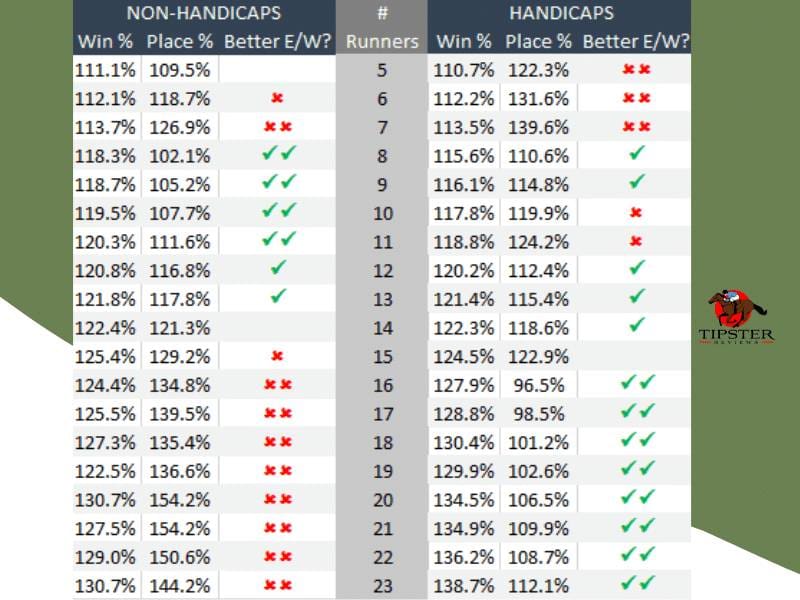
- 5-runner non-handicaps – The sweet spot where you get two places paid at 1/4 odds
- 8-10 runner non-handicaps – Maximum value at the threshold where three places kick in
- Exactly 8-runner handicaps – These “dead-eight” races offer exceptional each way value
- 16-17 runner handicaps – Four places paid creates opportunities for value
Conversely, each way betting becomes less favourable in races with 11-15 runners, where the field is large enough to reduce your placing chances but not large enough to trigger extra place payments.
Each Way Betting Guide – So How Does Each Way Betting Work
Here’s the nitty-gritty:
- You place your stake twice: once for the win, once for the place
- If your nag romps home first, you win both parts of the bet (cha-ching!)
- If it places but doesn’t win, you still get a payout on the place part
But here’s where it gets juicy – the place terms vary depending on the race. Check this out:
- Handicaps with 16+ runners: 1/4 odds for first 4 places
- Handicaps with 12-15 runners: 1/4 odds for first 3 places
- All other races with 8+ runners: 1/5 odds for first 3 places
- Races with 5-7 runners: 1/4 odds for first 2 places
- Races with fewer than 5 runners: Win only, mate!
Each-way betting works on horses in the following way: certain races pay out on more places, they are listed below along with the fractional payout terms if your horse’s place.
Remember, each way is 2 bets: a win bet and a place bet, so if your horse wins, you win half of the bet at the odds you placed it on, and the place part of the bet is paid out at a percentage of those odds, depending on the type of race and number of runners.
· Handicaps of 16 or more runners: 1/4 win odds on the first four places
· Handicaps of 12 to 15 runners: 1/4 win odds on the first three places
· All other races of 8 or more runners: 1/5 win odds on the first three places
· All races of 5 to 7 runners: 1/4 win odds on the first two places
· All races of fewer than 5 runners: win only
To clarify, let’s say using the same earlier example, you place a £5 each-way bet on Red Rusty at 5/1 (£10 total, £5 for the win, £5 for the place) in a 16-runner handicap horse race.
Red Rusty wins the race, so you will get a £5 win at 5/1 and also a £5 place at 1/4 odds as listed above (a quarter of 5/1 is 1.25/1)
Win payout = £30 (6×5)
Place payout = £11.25 (1.25×5)
The total payout for each way bet is £41.25
4th Place
Now let’s say that Red Rusty comes 4th in the race instead, your return will be the place part of the bet only, as it didn’t win the race, meaning you will win £11.25 (a profit of £1.25).
Hopefully, now you can see the perks of each-way betting. Obviously, larger odds horses make more sense to back each way, but anything under 4/1 is usually not worth it to back each way, as your returns if the horse places only will be under your stake.
Now you have an idea of what an each-way bet is, you may ask, ‘When is the best time to use each-way betting on horse racing?’ Keep reading…
Beyond Horse Racing: Each Way Opportunities
While each way betting is most commonly associated with horse racing, bookmakers offer this bet type across multiple sports:
Golf Tournaments – Each way betting truly shines in golf, where bookmakers regularly pay out 5, 6, or even 10 places in major tournaments. A £10 each way bet on a golfer at 50/1 with 1/4 odds and 8 places paid could return substantial profits even if your selection finishes 5th or 6th. The PGA Tour, European Tour, and major championships like The Masters all offer excellent each way opportunities.
Greyhound Racing – Similar rules to horse racing apply, with place terms varying by field size. Trap 1 and Trap 6 positions often provide statistical advantages that savvy each way punters can exploit.
Football Outright Markets – Bookmakers offer each way betting on league winners, top goalscorers, and relegation markets. Typically, they’ll pay 1/4 or 1/5 odds for 2-3 places. Backing an outsider each way to win the Premier League can provide returns if they finish in the top 2 or 3, depending on the bookmaker’s terms.
Snooker and Darts Tournaments – Major tournaments like the World Championship often feature each way betting with 2-4 places paid. This is particularly valuable when backing players who consistently reach semi-finals but rarely win the title.
When Should You Go Each Way?
Now, I’m not one to tell you how to spend your hard-earned cash, but here are some prime times to consider an each-way punt:
- Long Shots: Got a hunch about an outsider? Each-way betting lets you cash in even if it doesn’t quite seal the deal.
- Big Field Races: More runners mean more chaos. Each way gives you a safety net in unpredictable races.
- Form Horses at Decent Odds: Spotted a consistent placer at 6/1 or higher? Each way could be your new best friend.

As you can see by the table above, there is a clear indicator that races of 8 to 11 runners in non-handicaps and 16 runners plus in handicaps offer the best each-way betting opportunities.
On the other hand, though, it is rarely worth it to back each way rather than win only in 16-plus non-handicaps or 5- to 7-runner handicaps.
What About Enhanced Place Terms Then?
Earlier in this each-way betting guide, we mentioned the payout terms for each-way betting on horses; these are the standard place terms offered by all bookmakers in the UK and Ireland.
But from time to time, you may have noticed bookmakers offering enhanced place terms for each-way backers.
A prime example is the Grand National bookmakers, who often will offer 1/5 of the odds for up to 6 places, sometimes more. With over 40 runners often in this race, it’s still going to be tough to pick a winner or a place, but it does offer you more value than the standard place terms.
You will need to check what the terms and conditions are for enhancing place bets on a case-by-case basis, but the same concept applies to standard place terms.
Bookmakers like Betfair also now allow you to pick the number of places you want to back each way, and they adjust the odds for you in real-time so you can see your payouts.
If you struggle to calculate your potential payouts for each way, it’s recommended to use a betting calculator.
Each Way Betting Examples
Let’s put some meat on these bones with a real-world example:
You fancy “Lucky Lad” in the 3:30 at Cheltenham. It’s a 16-runner handicap, and Lucky Lad’s at juicy odds of 10/1.
You put £5 each way on Lucky Lad (that’s £10 total stake).
Scenario 1: Lucky Lad wins
- Win part: £5 x 10/1 = £50 profit
- Place part: £5 x 10/4 (remember, it’s 1/4 odds for place) = £12.50 profit
- Total return: £62.50 profit + £10 stake = £72.50
Scenario 2: Lucky Lad places (comes 2nd, 3rd, or 4th)
- Win part: £5 lost
- Place part: £5 x 10/4 = £12.50 profit
- Total return: £7.50 profit + £5 stake = £12.50
Not too shabby, eh?
Top Tips for Each Way Betting Success
- Do Your Homework: Know your horses, jockeys, and courses. Knowledge is power, punters!
- Shop Around: Bookies offer different place terms. Find the best deal for your bet.
- Consider Enhanced Place Terms: Some bookies offer extra places on big races. It’s like finding an extra tenner in your jeans pocket!
- Mind the Math: Each way betting doubles your stake. Make sure your potential returns justify the outlay.
- Track Your Bets: Keep a record of your each-way punts. It’ll help you refine your strategy over time.
Backing Favourites Each Way: The Contrarian Approach
Most punters assume each way betting is only for long shots, but mathematical analysis proves otherwise. Horses priced between 4/1 and 7/1 often provide the best each way value, not 20/1 outsiders.
Here’s why: a horse at 5/1 has a much higher probability of placing than winning. If you back it each way with 1/4 place terms, you’re getting 1.25/1 on the place portion – and that horse might have a 40-50% chance of placing compared to perhaps a 15% chance of winning. The mathematics heavily favour the place bet at these odds.
The Each Way Sniping Strategy
Professional punters use a technique called “each way sniping” – waiting until close to the off time and backing horses whose odds have drifted. If you identified a horse at 6/1 in the morning but it’s now 9/1, backing it each way gives you enhanced place returns at 2.25/1 (with 1/4 terms) while maintaining the same selection criteria you originally liked.
Split Stake Approach
Rather than placing a standard each way bet, some experienced punters split their stakes differently. For example, instead of £10 each way (£20 total), they might place £15 win and £5 place. This weighted approach works when you have a strong conviction about a horse’s winning chances but still want some place insurance.
The Rule of 8 Strategy
Target races with exactly 8 runners whenever possible. These “dead-eight” races offer the best mathematical edge because you get three places paid at 1/5 odds (in non-handicaps), giving you a 37.5% chance of a place return compared to 33.3% in a 9-runner race with the same terms.
Maximising Value Through Bookmaker Promotions
Smart each way punters never place a bet without first checking for enhanced place terms. During major racing festivals (Cheltenham, Royal Ascot, Grand National, etc.), bookmakers compete aggressively by offering:
Extra Places – Instead of the standard 3 places, bookmakers might offer 4, 5, or even 6 places paid. This dramatically increases your chances of a return. A 6-place offer in a 20-runner handicap means you have a 30% chance of placing compared to 15% with standard 3-place terms.
Enhanced Fractions – Some bookmakers increase the place fraction from 1/5 to 1/4 or even 1/3. This significantly boosts your returns. A horse at 10/1 with 1/3 place terms pays 3.33/1 on the place portion compared to just 2/1 at 1/5 terms.
Best Odds Guaranteed (BOG) – This applies to both the win and place portions of your each way bet. If you take 5/1 early morning and the horse goes off at 7/1, you’ll be paid at 7/1 for the win and 1.75/1 for the place (with 1/4 terms).
Critical Warning: Never blindly accept enhanced place terms if the bookmaker has slashed the win odds. Some bookmakers offer 5 places but reduce the horse’s odds from 8/1 to 6/1. Always compare the total potential returns before placing your bet.
Pitfalls That Cost Punters Money
Backing Extreme Longshots Each Way – Horses priced at 20/1 or higher rarely provide good each way value. The mathematics show that horses at 4/1 to 8/1 offer far better place returns relative to their place probability. A 25/1 shot might sound attractive, but its actual chance of placing is often less than 5%.
Ignoring Field Size – Placing each way bets in 11-15 runner races (non-handicaps) is often poor value because you’re stuck with only 3 places at 1/5 odds in a competitive field. Wait for 16+ runner handicaps where you get 4 places.
Not Comparing Bookmakers – Place terms vary significantly between bookmakers. One might offer 1/4 odds for 3 places, while another offers 1/5 odds for 4 places. Always use an odds comparison site to find the best each way value for your specific bet.
Doubling Stakes Without Proper Bankroll – Remember, each way betting doubles your stake. If you’re used to placing £10 win bets, placing £10 each way means you’re actually staking £20. Many punters blow through their bankroll faster than expected by not adjusting for this.
Betting Each Way on Favourites in Small Fields – In a 5-7 runner race, only 2 places are paid. If you back the favourite each way, you’re getting minimal value on the place portion because the favourite has a high probability of finishing in the top 2 anyway. Save your each way bets for bigger fields.
Essential Resources for Smart Each Way Punters
Each Way Calculators – Free online calculators allow you to input the odds, stake, and place terms to instantly see your potential returns for both win and place scenarios. These tools are invaluable for comparing whether an each way bet offers better value than a straight win bet on the same selection.
Expected Value (EV) Calculators – More advanced tools that help you determine the true mathematical value of an each way bet. Input your estimated win probability and place probability, and the calculator shows whether the bet has positive expected value. Professional punters use these religiously.
Odds Comparison Sites – Websites like Oddschecker display each way terms alongside the odds for every bookmaker. This allows you to quickly identify which bookmaker offers the best combination of odds and place terms for your specific bet.
Place Market Calculators – Some bookmakers now offer separate place-only markets. A place calculator helps you determine whether backing a horse each way is better value than backing it in the place market directly, or vice versa.
Each Way Betting During Major Racing Festivals
Cheltenham Festival – The pinnacle of National Hunt racing sees bookmakers offer enhanced place terms on almost every race. Expect 4-5 places paid instead of the standard 3, with some bookmakers offering 1/4 odds instead of 1/5. The competitive handicaps (like the Coral Cup and Pertemps Final) offer exceptional each way value.
Royal Ascot – Britain’s most prestigious flat racing meeting features large fields and competitive handicaps. Bookmakers routinely offer 5-6 places paid in races like the Royal Hunt Cup and Wokingham Stakes. These enhanced terms can turn a 10/1 shot finishing 5th into a profitable bet.
Grand National – With typically 30-40 runners, the Grand National is the ultimate each way betting opportunity. Bookmakers compete with offers of 6-8 places paid, sometimes at enhanced fractions. A horse finishing 6th at 25/1 with 1/4 odds for 6 places returns £72.50 profit from a £10 each way stake (£20 total).
Glorious Goodwood – This five-day festival features numerous competitive handicaps with 16+ runners, triggering 4-place terms. The Stewards’ Cup is particularly popular for each way betting due to its large field and unpredictable nature.
Strategy Tip: During festivals, place your bets early in the morning to lock in Best Odds Guaranteed, then benefit from both enhanced place terms and any positive odds drift throughout the day.
Each Way Doubles, Trebles, and Accumulators
How Each Way Multiples Work – When you place an each way double, treble, or accumulator, you’re actually placing two separate bets: one on all selections to win, and one on all selections to place. This means each way double costs twice the unit stake (e.g., £5 each way = £10 total).
Calculating Returns on Each Way Multiples:
For an each way double at 5/1 and 4/1 (both with 1/4 place terms):
- Win double: 5/1 × 4/1 = 30/1 (returns £155 from £5 stake)
- Place double: 1.25/1 × 1/1 = 2.25/1 (returns £16.25 from £5 stake)
- Total return if both win: £171.25 from £10 total stake
Partial Returns – The beauty of each way multiples is that you still get a return even if not all selections win. If one horse wins and one places in an each way double, you receive:
- Full win returns on the winning horse’s place portion
- Place returns on both horses in the place accumulator
When Each Way Multiples Make Sense:
- Short-priced selections (2/1 to 5/1) – These horses have higher place probabilities, making each way multiples more likely to return something
- Festival betting – When enhanced place terms are available across multiple races
- Combination betting – Pairing a strong fancy with a longer-priced selection
Warning: Each way multiples significantly increase variance and reduce your overall probability of profit. A straight each way treble requires all three horses to place just to break even in most scenarios. Use these bets sparingly and with smaller stakes.
Each Way Betting on Betfair Exchange
The Betfair Exchange operates differently from traditional bookmakers when it comes to each way betting:
Back to Place Markets – Instead of placing an each way bet, you can back a horse purely to place on the exchange. This removes the win portion entirely and allows you to focus solely on horses with strong placing chances. The odds are typically lower than bookmaker’s place odds, but you avoid tying up capital in the win bet.
Lay Betting Each Way – Advanced punters can lay horses each way on the exchange, effectively acting as the bookmaker. This means you’re betting against a horse winning or placing. The liability is higher, but the strategy can be profitable when you identify overbet horses.
Commission Considerations – Betfair charges 2-5% commission on net winnings (depending on your discount rate). Factor this into your calculations when comparing exchange place betting versus traditional each way bets with bookmakers.
Liquidity Issues – Not all races have sufficient liquidity in the place markets. Major races at Cheltenham, Ascot, and Aintree have deep place markets, but smaller midweek meetings may lack the volume needed for large stakes.
Record-Breaking Each Way Bets
The £1 Million Scoop – In 2011, a punter placed a £1.40 each way bet (£2.80 total) on a 10-fold accumulator. Nine horses won and one placed, triggering the place accumulator. The return: over £1.4 million. This remains one of the largest each way returns from a small stake in betting history.
The Grand National Windfall – Multiple punters have turned £10 each way bets into £50,000+ returns by backing longshots in the Grand National with enhanced place terms. In 2009, Mon Mome won at 100/1, delivering life-changing returns to those who backed it each way.
The Frankel Phenomenon – While Frankel was never backed each way due to his prohibitively short odds, his unbeaten record demonstrated the importance of place betting on second-favourites in races where one horse dominates the market. Backing the second-favourite each way in Frankel’s races often provided excellent value.
Horse Racing Each Way Betting Guide Summary
Each-way betting is a great way of reducing your losses. This is why this bet type is widely used by punters, especially if you use the data we showed you above to find the best race types and number of runners to target.
Each-way betting isn’t just a safety net – it’s a smart way to potentially boost your profits and get more bang for your buck. It’s perfect for those days when you’re feeling a bit adventurous but don’t want to go full maverick.
Remember, though, betting should always be fun. If the fun stops, stop. But if you’re ready to dip your toe into the exciting world of each-way betting, you’re now armed with the know-how to give it a proper go.
Got any questions? Winning stories to share? Drop us a line – we’re all ears! And don’t forget to check out our other betting guides and top tipster reviews. We’re here to help you become a shrewder punter, one bet at a time.
Now, go on and give each-way betting a whirl. May the horse be with you!
FAQ Section:
Each Way Betting: Your Questions Answered
Can I place an each way bet on the Tote?
Yes, the Tote offers each way betting on all races. However, the place dividend is determined by the pool, not fixed odds, so you won’t know your exact place returns until after the race. The Tote often provides better place value on outsiders but worse value on favourites.
What happens if there’s a non-runner in my each way bet?
If your horse is a non-runner, your entire stake is refunded (both win and place portions). If a different horse is withdrawn and it affects the number of runners, the place terms may change. For example, if a race drops from 8 to 7 runners, the places paid might reduce from 3 to 2.
Can I do an each way Lucky 15 or accumulator?
Yes, you can place each way multiple bets in each way, like Lucky 15s, Yankees, and accumulators. This doubles the number of bets and your total stake. An each way Lucky 15 contains 30 bets (15 win bets + 15 place bets), so a £1 each way Lucky 15 costs £30 total.
What does “win only” mean?
Some bookmakers offer a “win only” option when placing your bet. This means you’re declining the each way option and only betting on your horse to win. Your stake is halved compared to an each way bet.
Do extra places apply to ante-post betting?
Usually no. Enhanced place terms and extra places typically only apply to bets placed on the day of the race. Ante-post bets (placed days or weeks in advance) usually revert to standard place terms, although some bookmakers make exceptions during major festivals.
What if two horses dead-heat for a place?
If horses dead-heat for the final place position, your stake is divided by the number of horses involved, and you’re paid at full odds on that portion. For example, if two horses dead-heat for 3rd place in a 3-place race, you receive half your place stake at full place odds.