
JOIN OUR FREE TIPS GROUP

Join over 4,752 smart punters getting our winning tips every morning directly to your inbox or Telegram.

We respect your privacy. 100% free to join

bet tom

What Is Laying In Betting? Backing To lose!

So What Is Laying In Betting? Most people know how to place a bet, also known as “backing”, but not many people can tell you what “laying” a bet is when challenged.

To lay a bet is the opposite of backing and means to bet on something not to wi,n instead of it winning.

For example, Red Rum is running in The Grand National, and you think it’s not going to win, you would therefore lay this horse, meaning you win if the horse loses.

It gets a little more complicated with what you win, though, but once I show you, it will be just as clear to work out as backing a horse is if you want to know what is laying in betting, I suggest you keep reading.

Have you ever wondered about lay betting and how it’s changing people’s approach to gambling? I felt the same way before I found this fascinating betting technique!

Lay betting lets you bet on something NOT to happen. Traditional back betting involves wagering on outcomes, but lay betting puts you in a bookmaker’s shoes. You bet against an outcome and win if the selection loses or doesn’t happen.

The concept might seem tricky at first, but it’s simple. Here’s an example: if you lay a football team to win, you win your bet if that team loses or the game ends in a draw. You’re taking someone else’s bet on that selection.

Keep in mind that regular betting sites don’t offer lay bets. You’ll need a betting exchange to place these bets. The UK has four major betting exchanges where you can try this method.

Understanding liability plays a vital role in lay betting. Your liability represents the money you could lose in a worst-case scenario. Most bettors choose to lay at odds-on because it reduces their liability.

This piece will teach you everything about lay betting – from the basics to how it works on exchanges like Betfair. You’ll learn the step-by-step process and see how lay betting creates new opportunities for your betting strategy.

Let’s take a closer look at the exciting world of lay betting!

What Does Laying a Bet Mean?

The sort of thing I love about lay betting is that it feels like having a secret weapon in the betting world. This approach turns traditional betting upside down and gives us a fresh point of view with new ways to make strategic wagers.

Lay bet vs back bet

Back betting means I bet something will happen, like Manchester United winning their match. But with lay betting, I bet something will NOT happen. My laying a bet on Manchester United winning if they lose or draw their match.

The main difference comes down to who plays what role. Back betting puts me in the bettor’s seat, while lay betting lets me play bookmaker by offering odds to others. This switch creates a fascinating dynamic:

  • Back bet: I only win when my selection wins
  • Lay bet: I win if anything happens except my selection winning

The money side works differently, too. Back betting limits my loss to just my stake, no matter the odds. Lay betting ties my potential loss (liability) to the odds. A £10 lay bet on a horse at 3.40 odds means my liability would be £24.

Why does lay betting exist

Lay betting gives us flexibility that traditional bookmakers can’t match. The betting exchange model lets us switch between bettor and bookmaker roles, which opens up strategic possibilities.

Spotting losers comes more naturally than picking winners to many bettors. Take a horse race – it’s easier to pick one horse that won’t win than to nail down the winner. My lay bet in the Melbourne Cup with 24 horses means I back all but one of these horses to win.

Lay betting lets me:

  1. Lock in profits no matter what happens (as with trading stocks)
  2. Stop losses before events end
  3. Use odds movements to my advantage
  4. Handle multiple outcomes in one bet

The best part? Lay betting creates markets where bookmakers don’t go. Short prices or unlikely outcomes become opportunities – I can lay these instead of hunting for the actual winner.

Ground example of a lay bet

Let’s get into a tennis tournament example that shows lay betting in action:

Picture Novak Djokovic at the French Open with odds that seem too short and don’t offer value. Instead of guessing which player might win, I can lay Djokovic. This means I back everyone else in the tournament.

A £39.71 lay bet on Djokovic at 2.38 odds plays out like this:

  • My lay bet wins if Djokovic loses: I get the backer’s £39.71
  • My lay bet loses if Djokovic wins: I pay £79.42 to his backer

The liability math works this way: (Lay odds × Backer’s stake) – Backer’s stake = Liability (2.38 × £39.71) – £39.71 = £94.51 – £39.71 = £79.42

Football offers another great example. A €50 lay bet on Real Madrid against Napoli at 1.5 odds wins me €50 if Napoli wins or they draw. A Real Madrid win costs me €25.

Keep in mind that laying bets with odds under 2.0 means your liability stays lower than potential profit. That’s why laying favourites at short odds stands out as one of the safer betting approaches you can take.

How Does Lay Betting Work on Exchanges

Lay betting wouldn’t exist without betting exchanges. These platforms changed the betting world by letting bettors step into bookmakers’ shoes.

Role of betting exchanges

Betting exchanges work as digital marketplaces where customers can buy (back) and sell (lay) bets directly with each other. Traditional bookmakers always take the opposite position to customers. Exchanges simply match people who disagree about how an event will turn out.

This peer-to-peer system creates several benefits. The exchanges usually give better odds since they don’t add the profit margin that bookmakers do. They make money differently, too – by taking a small commission on winning bets instead of building margin into the odds.

The UK has four major betting exchanges (Betfair Exchange, Smarkets, Matchbook, and Betdaq). Betfair leads the pack with the highest trading volumes.

How are odds matched?

The exchange shows two sides of the market – blue boxes for back bets and pink boxes for lay bets. Here’s how the matching works:

  1. A layer offers odds on something not happening
  2. A backer who thinks that outcome will happen takes those odds
  3. The exchange creates a contract by matching these opposite positions

Exchanges shine because of their transparency. You can see the exact odds and the amount of money (liquidity) at each price point. When there isn’t enough money at your preferred odds, you might need different odds or wait for more liquidity.

Most exchanges let odds change in smaller steps compared to traditional bookmakers. A sportsbook might jump from 5/1 (6.0) to 9/2 (5.5). Exchanges allow tiny movements (6.0, 5.9, 5.8, etc.), which helps you get better value.

Understanding liquidity and market depth

Liquidity means the money available in a market at specific odds. You’ll see it shown under the odds in each market – that’s how much you can bet at that price.

Let’s say you want to lay £20 on a horse at 3.7 odds. If the liquidity shows only £17, your bet gets partially matched (£17). The remaining £3 stays unmatched until more money comes into the market.

Market depth reveals the full range of available odds and their liquidity. A “deep” market has lots of money at different price points. A “shallow” market lacks funds or has limited odds options. Popular events like Premier League matches and major horse races have the best liquidity.

The percentages above the markets tell an important story. They show the total probabilities across all selections. Numbers closer to 100% point to more competitive, value-rich markets. Your lay bets likely have less liability when these percentages approach 100%.

Learning these exchange mechanics helps you succeed at lay betting, especially as your strategies become more advanced.

How to Lay a Bet Step-by-Step

The concept makes sense now, so let’s walk through the practical steps of placing a lay bet.

Choosing a betting exchange

A betting exchange platform comes first on the list. Betfair and Smarkets stand out as the leading options. Betfair, 23 years old, dominates globally with over 4 million customers. Smarkets charges a flat 2% commission rate versus Betfair’s standard 5%. All the same, Betfair matches this rate with their ‘Basic’ rewards package.

Each platform shines in different ways. Betfair excels in liquidity for niche markets. Smarkets boasts a user-friendly design and cutting-edge features. Smart bettors should create accounts with both exchanges as backup options.

Finding a market to lay

The exchange selection leads to finding a suitable market. Betfair displays lay odds in pink boxes, while back bets appear in blue. Look for selections where you doubt the outcome—a football team likely to lose or a horse that probably won’t place.

Calculating your liability

Liability calculation precedes any lay bet—this represents your potential loss if the lay bet fails. Here’s the formula:

Liability = Stake × (Lay odds – 1)

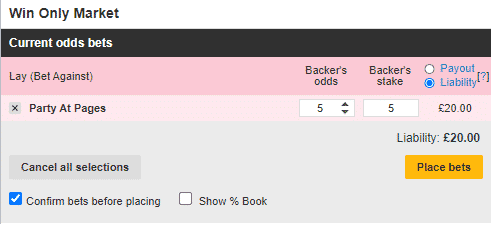
To name just one example, laying a horse at 3.0 odds with a £10 stake creates a £20 liability. Your liability stays nowhere near your potential profit at odds under 2.0.

Placing the lay bet

Betfair makes the process straightforward:

  1. Pick your target market
  2. Click the pink box for your lay selection
  3. Input your stake (your desired win amount)
  4. Review your liability (calculated automatically)
  5. Confirm by clicking “Place Bets”

The system deducts your liability from your account balance right after placing the bet.

What happens after placing the bet

Your lay bet results in one of two outcomes:

A winning lay bet (the outcome you opposed doesn’t happen) pays you the backer’s stake minus the exchange’s commission.

A losing lay bet (your opposed outcome happens) costs you your liability amount. Phil Mickelson at odds of 9 with a £10 stake means an £80 loss if he wins.

The exchange settles everything once the event ends and transfers any winnings to your account.

Lay Betting Explained Through Matched Betting


Lay betting is the foundation of a powerful betting strategy called matched betting. This technique changes bookmaker promotions into guaranteed profits. Let me explain this fascinating connection.

Why lay betting is essential for matched betting

Matched betting can’t exist without lay betting. This crucial element helps me cover all possible outcomes of an event and removes gambling risk. At the time I place a lay bet in matched betting, I become the bookmaker and sell a bet to other punters.

The basic principle is simple. I place a back bet at a bookmaker and then place a lay bet on a betting exchange against that same outcome. This “matching” process will give a profit, whatever the event’s result. Without knowing how to lay bets, I would only have traditional gambling options with their risks.

Using lay bets to tap into free bets

Lay betting works best to qualify for and extract value from bookmakers’ free bet offers. Here’s my typical approach:

  1. Place a qualifying back bet at a bookmaker to earn a free bet promotion
  2. Place a lay bet on the same selection on a betting exchange
  3. The original process costs a few pence but gives access to valuable free bets
  4. Place the free bet at the bookmaker (high odds work best)
  5. Lay against this selection at an exchange
  6. Get profit no matter what happens

This system works because the bookmaker pays for the free bet stake. When I use a free bet, I bet with the bookmaker’s money while my own funds cover all outcomes on the exchange.

How OddsMatcher tools make the process easier

Finding perfect matching opportunities by hand would take too long. OddsMatcher tools automate everything. These smart platforms scan data from over 100 bookmakers and betting exchanges. They rank potential matches by their rating percentage.

Matches closer to a 100% rating mean smaller losses on qualifying bets and bigger profits from free bets. These tools also have built-in calculators that work out exact stakes needed for both back and lay bets.

Advanced platforms like OddsMonkey merge with exchanges like Betfair. This allows one-click lay betting and eliminates mistakes. Technology has changed matched betting from complex math into an available strategy that consistently makes money.

Advanced Lay Betting Tips and Tools

After learning the basics, you can improve your lay betting game with advanced strategies and tools that will substantially improve your results.

Underlaying and overlaying strategies

Underlaying and overlaying are effective techniques that adjust your lay stake to optimise profits based on specific scenarios. You underlay a bet by staking less on the exchange than the standard calculator suggests, which increases your profit if the bookmaker bet wins. This strategy works well with offers where you receive a bonus if your back bet loses.

On the other hand, you overlay a bet by increasing your lay stake at the exchange. This reduces profit if the bookmaker bet wins, but increases your returns if the exchange bet wins. Overlay works best when placing trigger bets where you want a selection to win to activate a free bet.

Using lay bet calculators

Lay bet calculators are vital tools that show the potential payout and liability of any lay bet. These calculators consider odds, stake, and commission to give accurate figures without complex mathematics.

Most platforms offer specialised calculators for different scenarios:

  • Standard calculators for basic matched betting
  • Advanced calculators with underlay/overlay options
  • Sequential lay calculators for multiples betting

Today’s calculators merge with exchanges like Betfair, which allows one-click lay betting and removes human error.

Managing risk and commission

Discipline is vital for lay betting. Your individual wagers should never exceed 5% of your bankroll since lay betting can lead to big losses if not managed properly.

Liquidity in your chosen markets needs careful attention. Major horse races and elite football games offer better liquidity than lesser-known events. This means your bets match quickly at the best odds.

Note that commission affects your bottom line. While Betfair charges a standard 5% commission, Smarkets gives a flat 2% rate. We focused on markets with percentages close to 100%, as these show competitive, value-rich opportunities with potentially lower liability.

Laying In Betting – The Conclusion

Lay betting adds a powerful new dimension to any bettor’s toolkit. This piece shows how this approach turns traditional betting upside down. It lets me bet against outcomes instead of backing them. I’m basically stepping into a bookmaker’s role, which opens up possibilities that regular betting just can’t match.

Lay betting and betting exchanges go hand in hand. Platforms like Betfair and Smarkets have made betting more accessible to everyone. Their peer-to-peer model lets me match directly with other bettors who have different views.

New lay bettors must learn about liability first. You need to calculate potential losses with care before placing any lay bet. This becomes even more important with higher odds, where liability can grow much larger than your stake.

Matched betting is where lay betting really shines. Knowing how to cover all outcomes between bookmaker and exchange creates almost risk-free chances to profit from promotions and free bets.

Smart bettors should think about underlaying and overlaying strategies to boost profits in specific cases. These methods, combined with a specialised calculator, help me adjust my approach based on odds and commission rates.

Lay betting has its risks. Good bankroll management is crucial, and you need markets with enough liquidity. Even small differences in exchange commissions can affect your long-term profits a lot.

You can use lay betting to hedge existing bets, profit from bookmaker offers, or bet against overpriced favourites. It gives you options that traditional betting can’t. Next time you see odds that look too short, note that picking winners isn’t your only choice. You just need to spot what won’t win.

Your Laying In Betting FAQs

Q1. What is the main difference between a lay bet and a traditional back bet? A lay bet allows you to bet against an outcome happening, while a back bet is wagering on an outcome to occur. With a lay bet, you essentially act as the bookmaker, and you win if the selected outcome doesn’t happen.

Q2. How is my potential loss calculated in lay betting? Your potential loss in lay betting is called liability. It’s calculated by multiplying your stake by the lay odds minus 1. For example, if you lay £10 at odds of 3.0, your liability would be £20 ((3.0 – 1) x £10).

Q3. Where can I place lay bets? Lay bets can only be placed on betting exchanges, not on traditional bookmaker sites. The most popular betting exchanges include Betfair, Smarkets, Matchbook, and Betdaq, with Betfair being the largest and most widely used.

Q4. How does lay betting relate to matched betting? Lay betting is crucial for matched betting as it allows you to cover all possible outcomes of an event, eliminating gambling risk. By placing a back bet at a bookmaker and a lay bet on an exchange, you can guarantee a profit, especially when using free bet offers.

Q5. Are there any risks involved in lay betting? Yes, lay betting carries risks, particularly if not managed carefully. Your liability can be substantial, especially at higher odds. It’s important to never risk more than 5% of your bankroll on individual wagers and to pay attention to market liquidity to ensure your bets are matched quickly at optimal odds.